
Thickness
0.30 – 0.80 mm
Profiled roofing & cladding
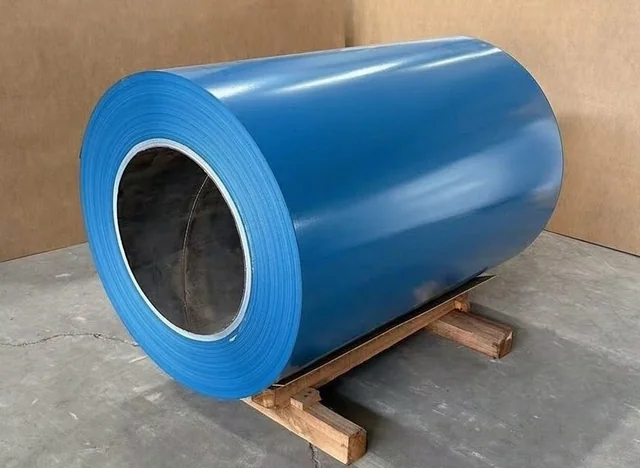
840 · 900 · 750 · 1050. 0.30–0.80 mm. Rolled from colour-coated coil, cut to the length your roof actually is.
The profile decides stiffness, the thickness decides span, and the container decides length. Get the third one wrong and the quotation is fiction — which is why we start there.
01 / Profiles
| Profile | Wave height | Pitch | Effective width | Feed width | Best for |
|---|---|---|---|---|---|
| 840 | 25 mm | 210 mm | 840 mm | 1000 mm | General roofing — warehouses, workshops, sheds |
| 900 | 15 mm | 225 mm | 900 mm | 1000 mm | Wall cladding, light roofing |
| 750 | 35 mm | 125 mm | 750 mm | 1000 mm | Long span, high wind load |
| 1050 | 15–25 mm | 250 mm | 1050 mm | 1200 mm | Wide wall panels, fewer laps |
Profile codes follow the Chinese YX convention (wave height – pitch – effective width). Drawings for each section are available on request.
02 / Choosing
25 mm of wave gives stiffness without wasting width, and every accessory on the market is made for it. If you have no reason to choose otherwise, choose 840.
Deeper wave, shorter pitch, more steel per square metre. For long spans and high wind load, where a lighter sheet would need purlins closer together.
On a wall you want a flat face and fewer laps, not stiffness. 1050 covers more per sheet; 900 is the lighter, more common wall profile.
0.30 mm exists and sells, but a coastal roof in 0.30 mm is a repair waiting to happen. 0.45–0.55 mm covers most industrial work.
03 / Length
This is the sentence most suppliers leave out of the quotation. The sheet you can actually buy is the sheet that fits the box, minus a hand's width for the door and the dunnage.
| Container | Internal length | Maximum sheet | Typical use |
|---|---|---|---|
| 20GP | 5.90 m | 5.8 m | Single-length roof, small building |
| 40GP | 12.03 m | 11.8 m | Most industrial roofs |
| 40HQ | 12.03 m | 11.8 m | Same as 40GP — height buys volume, not length |
| Over 11.8 m | — | flat rack / open top | Different freight entirely |
Quote it by square metre, load it by cubic metre. Profiled sheet is volume cargo, not weight cargo — a 20GP fills up long before it reaches 25 t.
04 / Finishing
Both ends sheared and deburred, so the cut edge does not start a rust line under the lap.
Interleaved, strapped, edge-protected. Bundles sized to what your crane or telehandler lifts.
Profile, thickness, colour, length and piece count on every bundle — readable from the truck.
Ridge, barge, flashing, self-drilling screws and EPDM washers can be arranged with the panels.
05 / Application
Industrial and warehouse roofing · workshop and shed roofs · wall cladding · canopies and carports · agricultural buildings · site hoarding · renovation over an existing roof.
06 / Frequently asked
At 0.50 mm on the 840 profile, about 4.4 kg/m². At 0.40 mm, about 3.5 kg/m². Tell us the profile and thickness and we will confirm.
Depends on wind and snow load and on thickness. Send the span and the design load; we will come back with a thickness rather than a guess.
2 t, which at 0.50 mm on 840 is roughly 450 m². One container can mix profiles, colours and lengths.
Within RAL, yes from 2 t. Outside RAL needs a sample and a longer run.
Ridge, barge, flashing and fasteners can be arranged with the sheets so the roof does not arrive ninety percent complete. Send your accessory list and we will quote it with the panels.
15–20 days for profiled sheet, 20–25 days if the coil itself has to be coated to your colour first.