
What 840, 900, 750 and 1050 Mean on a Metal Roofing Sheet
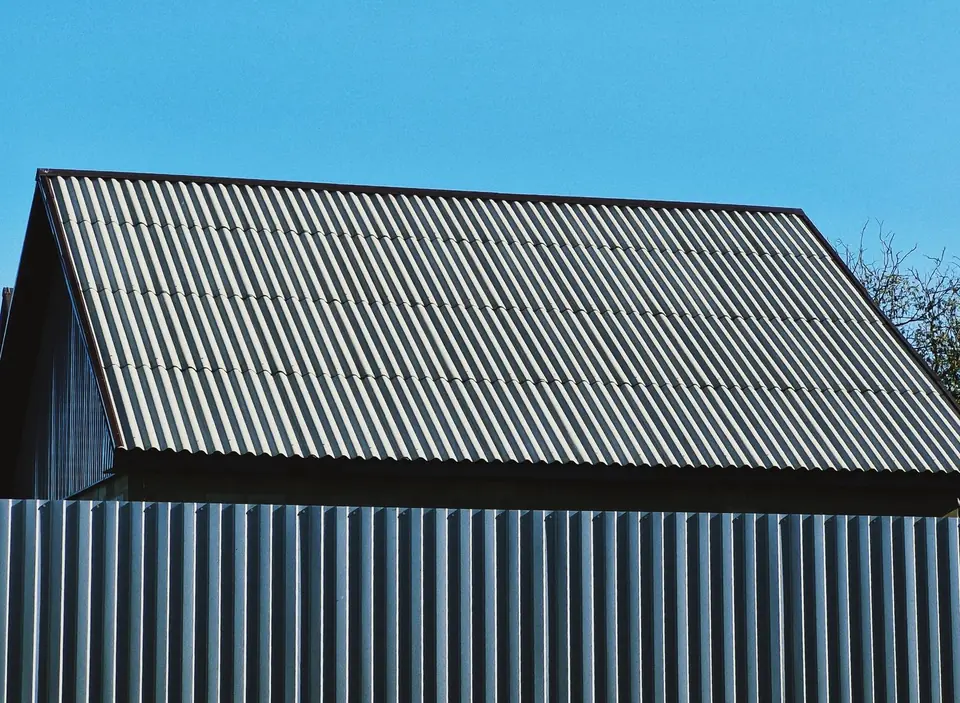
A quotation for “colour-coated roofing sheet” is not an order until the section is named. The profile decides stiffness, the thickness decides span, and the container decides the length you can actually ship. Get the third one wrong and the quotation is fiction — which is why we start there.
The four standard sections we roll are 840, 900, 750 and 1050, in thicknesses from 0.30 to 0.80 mm, up to 11.8 m long. They are rolled from colour-coated coil and cut to the length your roof actually is.
How to read the code
Profile codes follow the Chinese YX convention: wave height, then pitch, then effective width. So 840 is the everyday name for a section whose effective cover is 840 mm; the full designation is wave height – pitch – effective width. Drawings for each section are available on request.
| Profile | Wave height | Pitch | Effective width | Feed width | Best for |
|---|---|---|---|---|---|
| 840 | 25 mm | 210 mm | 840 mm | 1000 mm | General roofing — warehouses, workshops, sheds |
| 900 | 15 mm | 225 mm | 900 mm | 1000 mm | Wall cladding, light roofing |
| 750 | 35 mm | 125 mm | 750 mm | 1000 mm | Long span, high wind load |
| 1050 | 15–25 mm | 250 mm | 1050 mm | 1200 mm | Wide wall panels, fewer laps |
Which profile, and why
840 — because everything fits it. 25 mm of wave gives stiffness without wasting width, and every accessory on the market is made for it. If you have no reason to choose otherwise, choose 840. It is the general-roofing section for warehouses, workshops and sheds.
750 — when wind does the deciding. A deeper wave and a shorter pitch put more steel per square metre. Use it for long spans and high wind load, where a lighter sheet would need purlins closer together.
900 and 1050 — coverage, not depth. On a wall you want a flatter face and fewer laps, not the same stiffness a roof needs. 1050 covers more per sheet; 900 is the lighter, more common wall profile.
Thickness. 0.40–0.60 mm is the working range. 0.30 mm exists and sells, but a coastal roof in 0.30 mm is a repair waiting to happen. 0.45–0.55 mm covers most industrial work. The full range we roll is 0.30–0.80 mm. Purlin spacing depends on wind and snow load and on thickness — send the span and the design load, and we will come back with a thickness rather than a guess.
The sheet you can actually buy is the one that fits the box
A 12-metre sheet does not fit in a 20-foot container. This is the sentence most suppliers leave out of the quotation. The sheet you can actually buy is the sheet that fits the box, minus a hand’s width for the door and the dunnage.
| Container | Internal length | Maximum sheet | Typical use |
|---|---|---|---|
| 20GP | 5.90 m | 5.8 m | Single-length roof, small building |
| 40GP | 12.03 m | 11.8 m | Most industrial roofs |
| 40HQ | 12.03 m | 11.8 m | Same as 40GP — height buys volume, not length |
| Over 11.8 m | — | flat rack / open top | Different freight entirely |
Quote it by square metre, load it by cubic metre. Profiled sheet is volume cargo, not weight cargo — a 20GP fills up long before it reaches 25 t.
What a square metre weighs, and what two tonnes buys
At 0.50 mm on the 840 profile, a square metre weighs about 4.4 kg. At 0.40 mm, about 3.5 kg/m². Tell us the profile and thickness and we will confirm.
The minimum order is 2 t, which at 0.50 mm on 840 is roughly 450 m². One container can mix profiles, colours and lengths.
What to put on the purchase order
Write the profile, the thickness, the colour, the length and the piece count. Every bundle is marked with those five things, readable from the truck. Both ends are sheared square and deburred, so the cut edge does not start a rust line under the lap. Bundles are interleaved, strapped and edge-protected, sized to what your crane or telehandler lifts.
Colour is specified in RAL. Within RAL we can match from 2 t; a colour outside RAL needs a sample and a longer run. Ridge, barge, flashing, self-drilling screws and EPDM washers can be arranged with the panels so the roof does not arrive ninety percent complete — send the accessory list and we will quote it with the sheets.
Lead time is 15–20 days for profiled sheet, or 20–25 days if the coil itself has to be coated to your colour first.
Send a profile, a thickness, a colour and a length. Write to us and we will tell you what fits the container.
*— Yueyang Technology, Bazhou, Hebei. Write to us — David Hu, General Manager.*