
Mobile Whiteboard Stands: The Castor Load Math Buyers Never Check
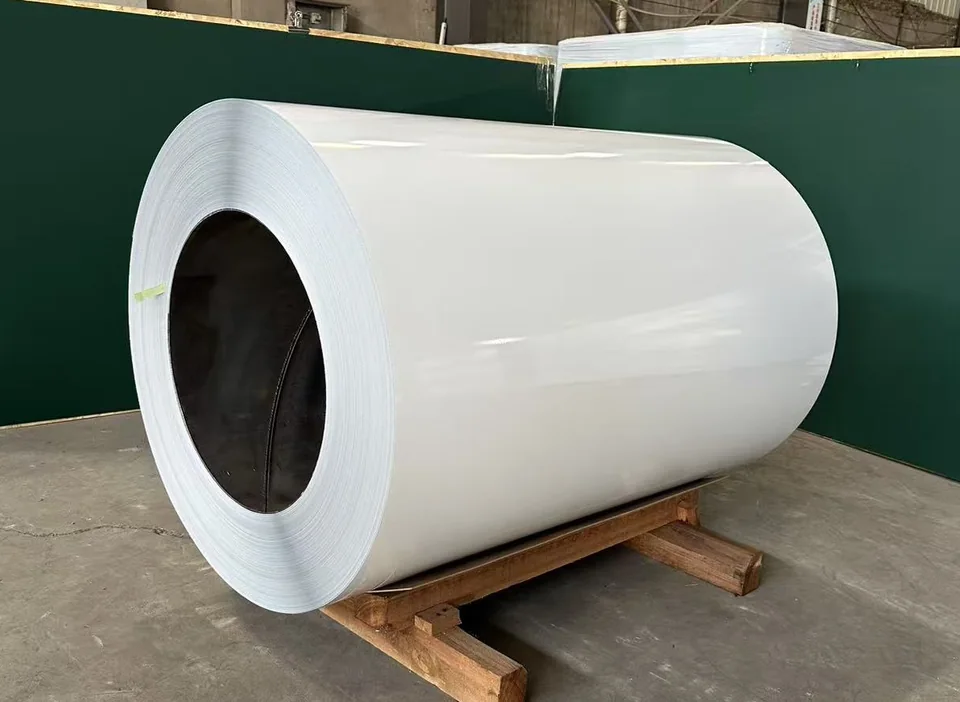
Every few weeks a buyer sends a photo of a mobile whiteboard that collapsed in a school corridor with the same sentence: the stand was rated for 50 kg per wheel. It was. The rating is real and the failure is real, because a castor rating is a static number measured on a smooth steel plate, and a mobile board in a school is neither static nor on a steel plate. We make the panels, not the stands, so there is no product of ours to defend here; the arithmetic below is what we send when a buyer asks how to pair them.
Start with the real weight, not the panel weight
Panel weight is pure physics. Steel is 7,850 kg per cubic metre, so a square metre of substrate weighs 7.85 kg for every millimetre of thickness, and the coating adds about 0.1 kg per square metre at 20 microns. A 1.2 x 2.4 m board is 2.88 m², which gives these panels.
| Substrate | Panel weight, 1.2 x 2.4 m | Where it belongs |
|---|---|---|
| 0.30 mm | 6.8 kg | fixed wall boards, light duty |
| 0.40 mm | 9.0 kg | mobile boards, the standard choice |
| 0.50 mm | 11.3 kg | large format, heavy handling |
| 0.60 mm | 13.6 kg | double-sided premium, rough sites |
The panel is rarely more than a quarter of the total. Add an aluminium perimeter frame in 40 x 40 x 1.2 mm profile at roughly 0.5 kg per metre of the 7.2 m perimeter, so 3.6 kg plus 1 kg of corners and bracing. Single-sided, that is 9 kg of panel, 6.5 kg of 3 mm MDF stiffener and 15 kg of steel H-frame: 34 kg. Double-sided, the second panel replaces the MDF stiffener for almost the same weight, so two panels, the frame and a slightly heavier stand come to about 40 kg. Add a pen tray, a dozen magnets, two kilos of markers and a flipchart pad clamped to the top and the working weight is 45 kg. Anyone quoting "20 kg board" is quoting the panel alone and hoping nobody adds it up.
A castor rating is static, and your corridor is not
The number stamped on a castor is a static load on a flat plate, and industry practice derates it for dynamic service. A 50 mm castor rated 40 kg runs for years at 25 kg and starts shedding its tyre at 35 kg once it crosses door thresholds twice a day. A 75 mm castor rated 60 kg is comfortable at 40 kg; a 100 mm castor rated 90 kg barely notices.
The working rule is a safety factor of three on the total. A 45 kg board needs 135 kg of combined capacity, and four 40 kg castors give 160 kg — a pass, but only if the load is shared. It is not. Push from one corner and the two castors under your hands take most of the weight while the far pair unloads and skids. Assume two castors carry 70% of the load and the 160 kg of nominal capacity becomes 112 kg against a 135 kg requirement. That is how a stand rated 50 kg per wheel ends up on the floor of a corridor.
Base depth decides whether it tips
A board tips when a shove at the top overcomes the restoring moment of its own weight: the threshold force is the weight times half the base depth, divided by the push height. A 45 kg board on a 1.9 m frame with a 0.5 m base tips at 58 newtons; a 0.6 m base raises that to 70. A running child delivers well over 100. Base depth should be at least a third of board height, and a two-column A-frame with feet front and back beats a single post whatever its castors say. The same logic kills tall narrow boards: a 1.2 x 2.4 m portrait board on a 0.45 m base is a hazard in any room with children in it, and we say so when the enquiry asks for one.
The four joints that fail first
Load ratings rarely cause the collapse. These do, in the order we see them.
- Castor stem pulling out of the leg. Expanding stems in 1.0 to 1.2 mm wall tube hold well vertically and badly in shear. Drag the board sideways over a threshold and the stem cocks in the tube, the expansion loosens, the castor departs. Look for a welded plate or a through-bolt, not just a stem, on anything above 35 kg.
- H-frame bolt holes elongating. A bolted cross-brace works loose in a term, the holes ovalise, the frame racks, and the board develops a lean that no tightening fixes.
- Rivets tearing through the panel. Eight to ten rivets per long edge is the right count on 0.4 mm. Corner rivets take the racking load when the board is pushed from a corner, and a 4.8 mm rivet in 0.4 mm steel tears a slot before it shears. That slot is where rust starts on an edge nobody sealed.
- Panel bow at the frame line. Push a 2.4 m board from one corner and the panel bows 5 to 8 mm across the diagonal. Repeated flexing crazes the coating at the rivet line. This is the argument for 0.4 mm over 0.3 mm on anything mobile: the 0.3 mm panel is 25% lighter and visibly more flexible in the hand.
Match the wheel to the floor, not the catalogue
Hard nylon rolls easily, is loud on tile and marks light vinyl. Soft rubber or TPR grips quietly but ruts into thick carpet and needs a shove to start. Polyurethane is what we suggest for mixed school floors. Diameter beats material on bad surfaces: 50 mm wheels stop dead at a 15 mm threshold, 75 mm climbs it, 100 mm ignores it. Two braked castors are the minimum, ideally a diagonal pair so the board cannot pivot when parked.
What to put on the order
Six lines settle it: board size and substrate thickness, number of panels, total assembled weight, floor surface, the highest threshold the board must cross, and castor diameter with its dynamic rating. Send those and any stand maker can quote properly, and you will know before the container ships whether the cheap stand is cheap. We would rather write "castors 75 mm, dynamic 45 kg each, two braked" on a confirmation than hear about a collapsed board eight months later.
*— Yueyang Technology, Bazhou, Hebei. Write to us — David Hu, General Manager.*