
Porcelain Enamel vs Coated Steel Whiteboard Panels: What the Extra Money Actually Buys
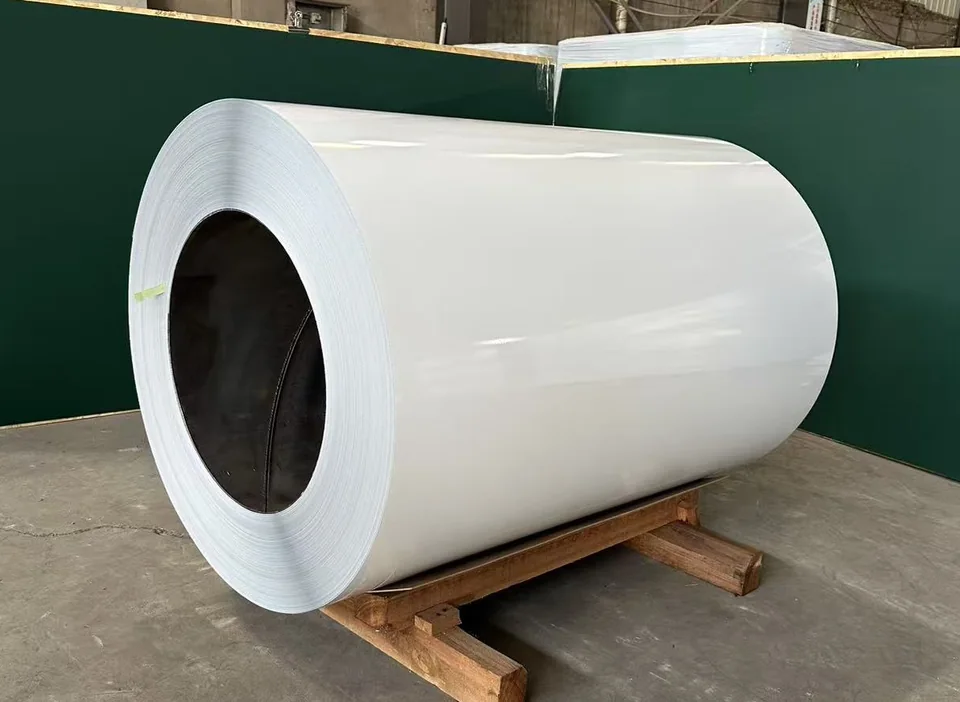
A procurement manager at a Turkish school-furniture group asked us a fair question last spring: if enamel whiteboards last thirty years and ours last ten, why would anyone buy ours? We sent him both, at our own cost, because the answer is easier to show than to argue. The enamel panel erased as cleanly on day one as ours did. It also weighed 40% more, cost us roughly 2.5 times per square metre, and arrived with a chipped corner from a knock that would have bounced off our coating. This article is the written version of that comparison — including the parts where enamel genuinely wins.
What enamel actually is
Vitreous enamel is glass. Finely ground frit is mixed with water into a slip, sprayed or roller-coated onto steel, then fired in a furnace at roughly 800–850 °C, where the glass melts and fuses chemically to the metal. The writing surface is effectively a thin layer of ceramic. That structure explains every advantage and every weakness that follows: a ceramic surface is extremely hard — around 6–7 on the Mohs scale, far beyond the 2–3H pencil hardness of a polyester topcoat — it is inert to permanent markers, solvents, UV and most chemicals, and it does not ghost even after decades of daily dry-erase use. It is also brittle. A sharp edge impact that a 15–20 micron organic coating absorbs elastically will crack or chip fired glass, and a chipped enamel face cannot be repaired, only replaced.
Where the durability difference is real — and where it is not
| Factor | Porcelain enamel | Coated steel (polyester/PE) |
|---|---|---|
| Writing surface hardness | ~6–7 Mohs, scratch-proof in normal use | 2–3H pencil, resists eraser wear, not keys |
| Permanent marker / solvent | wipes off with acetone, no damage | may stain permanently if not cleaned fast |
| Expected service life, heavy daily use | 20–30 years | 8–12 years |
| Cost per m², FOB | 2.0–3.0× | baseline |
| Panel weight, 1.2 × 2.4 m | 12–14 kg | 8–10 kg |
| Impact behaviour | chips, unrepairable | dents or scratches, board stays usable |
| Magnetism | magnetic (steel core) | magnetic (steel core) |
| Freight per 40HQ container | ~25–30% fewer boards | maximum loading |
Read that table honestly and the premium splits into two piles. The real part: scratch immunity, solvent immunity, and a service life that spans a generation of students. If your boards will be written on forty times a day by children, a coating that costs one third as much but lasts one third as long is not obviously the bargain — especially once replacement labour and classroom downtime are counted. The inflated part: the weight and the freight. Enamel boards need thicker steel to survive firing and handling, and weight multiplies at every logistics step. On a full 40HQ to Varna or Jebel Ali, the difference is roughly 200–250 boards of lost loading, which alone can erase much of the per-board cost gap at retail.
The failure modes buyers never ask about
We sell against enamel often enough to know where it disappoints, so here is the mirror view of our own product's weaknesses. Coated steel will ghost if ink dwells: a dry-erase line left over a humid weekend, or a permanent marker trace nobody noticed for two days, can set into the topcoat and never fully come out. Enamel shrugs both off. Coated steel also has a finite eraser budget — thousands of cycles, not infinite — and abrasive pads will dull gloss locally. And a hot shipping container matters less for coating than for film, but a coated panel stored face-to-face in condensation will show water marks that enamel will not.
Enamel's weaknesses are quieter but more expensive. Chips concentrate at corners and edges, exactly where handling hits, and one chipped corner on a display board in a school corridor is a warranty claim, not a touch-up. The firing process also fights flatness: large enamel panels more frequently show slight waviness under raking light than cold-rolled coated steel, which never sees 800 °C. And enamel writing surfaces have marginally more drag — teachers notice the difference on long equations, some prefer it, some do not.
A decision rule that has held up
After a decade of quoting both worlds, one question sorts most buyers: how many write-erase cycles per day, and who pays for replacement? Above roughly twenty cycles a day — classrooms in daily rotation, training centres, factory scheduling boards — enamel's life-cycle cost genuinely wins, and we say so. Below that — offices, meeting rooms, home boards, retail furniture where the board is one component of a product — coated steel wins on cost, weight, flatness and freight, and a 2.5× surface premium buys a durability nobody will use up before the furniture itself is replaced. The awkward middle is schools buying for ten-year budget cycles: there, the honest answer is that a good coated steel board refreshed once costs about the same as one enamel board, with the freight advantage on our side and the chip risk on theirs.
What we will not claim
We do not claim our coating equals enamel. It does not, on hardness, solvent resistance or lifespan, and a supplier who says otherwise has never run a permanent marker across both and walked away for a weekend. What we claim is narrower: for the majority of writing volumes outside intensive classrooms, a properly cured polyester coating on 0.4 mm galvalume delivers eight to twelve years of service at one third the surface cost, flatter panels, 30% more boards per container, and a failure mode — a dent, a scratch — that leaves a board usable instead of a claim form. If your usage profile is the heavy one, buy enamel, from whoever makes it well. If it is not, spend the difference on something your customers will notice.
*— Yueyang Technology, Bazhou, Hebei. Write to us — David Hu, General Manager.*