
How Long Can Coated Steel Whiteboard Panels Sit in Storage Before They Go Bad?
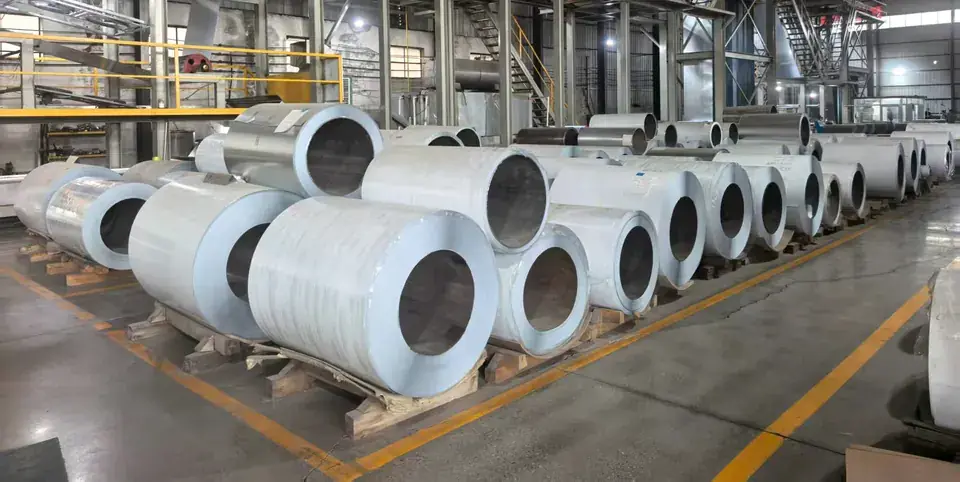
A distributor in Burgas ordered 3,200 m² of 0.4 mm gloss white in spring 2025 and installed most of it that summer. The rest sat in an unheated warehouse through a Black Sea winter and a hot July, still on our pallets, still in our film. When his fitter opened the last three pallets in September, the panels were flat and the colour was right, but the film came off in shreds and left a sticky haze across roughly 40 m². That haze is adhesive, and it does not wipe off with a dry eraser. Nothing was wrong with the steel. Everything was wrong with fourteen months of storage.
Four things degrade, and only one is the coating
It helps to separate the failure modes, because they run on different clocks.
| What degrades | Cause | First sign | Typical onset |
|---|---|---|---|
| Protective film | adhesive ageing, heat, UV | film stiffens, tears instead of peeling | 4–6 months at 20–25 °C, 2–3 months above 35 °C |
| Cut edges | moisture trapped between panels | white rust, then red rust creeping inward | 3–8 weeks in a humid stack |
| Flatness | point loads from bearers and pallet corners | oil-canning under grazing light | 3–6 months under load |
| Surface gloss | condensation cycling, dust under film | dull patches, faint water marks | 6 months and beyond |
The paint is the toughest part of the assembly. A properly cured polyester coating on 0.4 mm substrate will outlast the building it is stored in. What fails first is the packaging and the edge, and both fail from moisture that never had a chance to escape.
The stack height that quietly bends panels
A 1.2 × 2.4 m panel at 0.4 mm weighs 9.0 kg. A hundred panels on a pallet is 900 kg of steel plus 25 kg of timber — a light pallet in our dispatch bay. Stack five and the bottom one carries 3.6 tonnes across 2.9 m², which the steel handles fine in compression and badly in bending if the pallet below lost a bearer.
Two rules cover most of it. Stack no more than four pallets high, and only on pallets with a full timber deck rather than three bearers and a gap. Panels supported at three lines instead of continuously sag over months, and the sag does not come out when the load is removed — a 1–3 mm wave appears the moment the board is mounted and light rakes across it. That is the most common complaint we investigate where panels left here flat. Coils follow the same logic in another shape: two high without saddles, three with hardwood saddles spreading load across the full width, never stood on edge against a wall.
Condensation does more damage than rain
An unheated warehouse breathes. Warm humid afternoon air enters at 28 °C and 70% relative humidity, putting the dew point near 22 °C. Overnight the steel, sitting against a cold concrete floor, drops below that. Water condenses on the metal and, with panels stacked face to face and film between them, it has nowhere to go. It sits in the gap, feeds the unprotected cut edge, and starts the white rust that turns red around week six.
The countermeasures are cheap and almost always skipped. Put pallets on 100 mm timber bearers, not directly on concrete, and leave 100 mm to the wall so air moves behind the stack. Do not wrap a stack in a closed tarpaulin: a sealed tarp over cold steel is a condensation chamber, and we have seen stacks that were drier before they were "protected". Keep the stack out of direct sun, because a south-facing wall in summer runs 10–15 °C above ambient and roughly doubles the film ageing rate.
The six-month film clock
Our standard protection is 60 micron polyethylene with rubber-based adhesive at 8–12 g/m², specified for six months of indoor storage at moderate temperature and easy peel in one piece. Every number there is conditional. At 35–40 °C in a metal-roofed shed the adhesive cross-links faster and the window drops to two or three months. Past that the film still protects the surface but stops being removable, and removal becomes a production step: solvent, rags, and a real risk of dulling gloss where solvent dwells.
So we say two things plainly. If you will not install within six months, ask for UV-stabilised film at order; it buys roughly twelve months indoors for a few cents per square metre. And if the goods must sit outdoors under a tarp, do not buy our standard packing — we will quote a heavier wrap with edge boards and desiccant, and we will also tell you the risk is yours and we have seen it fail.
Ten minutes to judge old stock
Before a fitter cuts into a pallet that has sat for a year, four checks:
- Peel a corner of film on the top panel. One continuous sheet with no residue line means the stack is fine. Tearing every 200 mm means stop and test a second pallet.
- Look at the cut edges on all four sides. White powder is early zinc corrosion and comes off with a nylon pad. Brown staining that will not wipe means the edge has gone; those panels belong on a dry interior wall, not a humid corridor.
- Lay a panel face up on flat floor and sight along it. More than 2 mm of wave over 2.4 m will show on a wall.
- Wipe one square metre with a dry eraser, then a water-damp cloth. If the surface grabs the cloth or leaves a chalky trace, condensation has compromised the topcoat.
Put storage on the order, not in the warehouse manual
The most useful sentence a buyer can send us is how long the goods will sit before installation. It changes the film, edge protection, pallet deck and sometimes the coating system, and it costs far less than replacing forty square metres of damaged board. We would rather write "storage up to nine months, UV film, full deck pallets" on the order confirmation than hear about it a year later.
*— Yueyang Technology, Bazhou, Hebei. Write to us — David Hu, General Manager.*