
What Certificates Do Public Tenders Actually Ask For? A Paperwork Checklist for Coated Steel Whiteboards
Last November a procurement officer in Sofia sent us a fourteen-line document schedule with nine days to the bid deadline. The panels were nothing unusual — 2,400 m² of 0.4 mm gloss white, RAL 9016, cut to 1.2 × 2.4 m. We could have made them in three weeks. We did not bid: line nine asked for a reaction-to-fire classification to EN 13501-1 on the finished build-up, and we do not hold one. On coated steel panels the technical compliance is rarely the obstacle; the paperwork is. Here is the schedule as it actually arrives, what each document proves, and where bids die.
Three kinds of paper, three very different weights
Buyers, and plenty of sales people, use "certificate" for everything. There are three distinct documents here, and evaluators score them differently.
| Document | Issued by | What it actually proves | Cost and lead time |
|---|---|---|---|
| Test report | ISO/IEC 17025 accredited laboratory (SGS, Intertek, TÜV) | the measured performance of the exact sample submitted | USD 400–2,500 per standard, 2–6 weeks |
| Management system certificate | accredited certification body | how the plant is run, not how the product performs | USD 3,000–8,000 initial audit, annual surveillance, 3-year cycle |
| Supplier declaration / DoC | us, on letterhead | a legal statement by the seller, no third-party evidence | hours |
A tender that says "ISO 9001 certificate required" cannot be satisfied by a declaration. A tender that asks for REACH compliance usually can only be satisfied by a declaration, because there is nothing to measure: SVHC compliance is a check of the bill of materials against a substance list, not a lab test. Knowing which is which tells you quickly whether a bid is winnable.
The list that shows up most often
Across EU, Gulf and UN-agency tenders for classroom boards, the same eight items recur. Status is ours, as of today.
| Document | Covers | Our status |
|---|---|---|
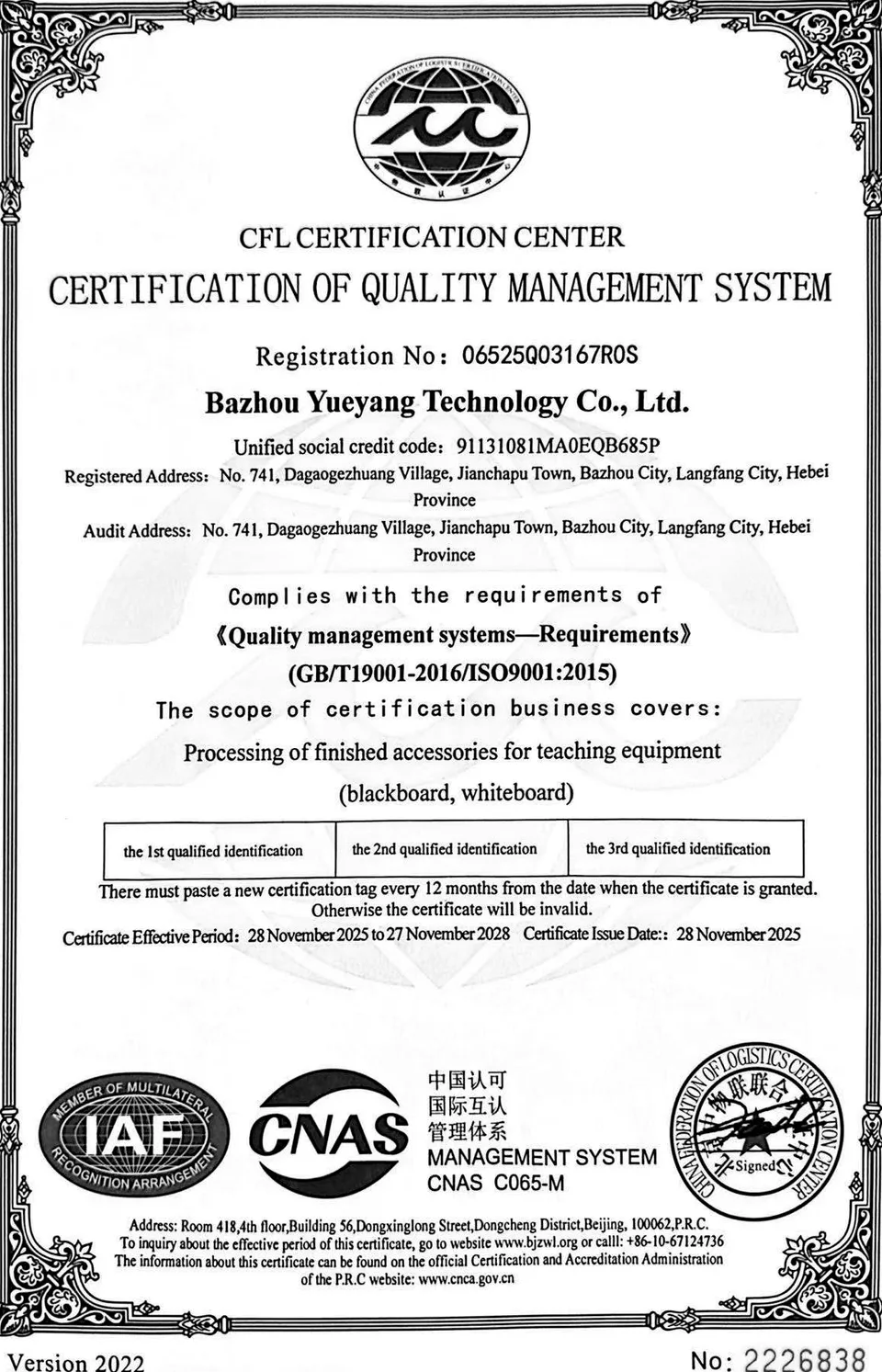
| ISO 9001:2015 | quality management system at the coating plant | Held — reg. 06525Q03167R0S, CFL Certification Center, CNAS C065-M, valid to 27 Nov 2028 |
| EN 71-3:2019+A2:2024 | migration of 19 elements from the coating (toy-safety logic, applied to school furniture) | Held — SGS XMHL250400224501TY, Apr 2025, PASS; soluble lead and cadmium not detected |
| EN 71-2:2020 | flammability of the coated surface | Held — same SGS report, PASS |
| EU RoHS (EU) 2015/863 | ten restricted substances in the coating | Held — SGS XMHL2209007038SD, Oct 2022, all not detected or far below limits |
| REACH SVHC declaration | candidate list substances above 0.1% w/w | Declaration per shipment; list now past 240 substances, revised twice a year |
| EN 13501-1 reaction to fire | fire class of the finished board, typically B-s1,d0 | Not held — see below |
| VOC / ISO 16000-9 chamber emission | indoor air emissions from the finished panel | Not held |
| EN 10204 3.1 mill certificate | substrate: zinc weight, coating weight, heat number | Issued per coil by the steel mill, travels with the goods |
Two of these get misunderstood. EN 71-3 is a toy standard, and a whiteboard is not a toy — but a school board is touched by children, and several EU education frameworks borrow the toy migration limits as a proxy for "safe to touch" — which is why we test to it. And ISPM 15 is not a product certificate at all: it applies to the wooden pallet or crate, requires heat treatment to 56 °C core for 30 minutes with the IPPC stamp on two sides, or a plywood substitute that is exempt as processed wood. Solid-wood pallets without a stamp can be refused at the border, however good the panels are.
The two we do not hold, and what it would take
EN 13501-1 is the one that costs us bids. The classification is earned by testing the exact build-up — steel, coating, adhesive, backing, frame — to EN 13823 (the SBI test, 1.5 × 1.0 m specimens) plus small-scale tests, in a notified laboratory. Budget EUR 3,000–6,000 and six to ten weeks including getting specimens there. The resulting class belongs to that build-up, not to "our panels" in general. Change the adhesive or the backing and the paper is void. If a tender is six weeks out, we cannot manufacture that document in time — we say so at enquiry, not after award.
Chamber VOC testing to ISO 16000-9 is a 28-day emission test on a full panel in a controlled chamber, relevant where a buyer applies indoor-air specs to classrooms. No private customer has ever asked us for one.
Three mismatches that disqualify an otherwise compliant bid
- Validity windows. Many evaluators require test reports issued within three years. Our RoHS report is from October 2022; on a strict 2026 tender it may be rejected as stale though the coating has not changed. We re-test when a project needs it — four to five weeks.
- Sample description. A report is valid only for what it names. Ours names a white coating on metal substrate; if the tender is for matte green RAL 6021, an evaluator can reject the report as covering a different product. Ask for the sample description page before you build a bid on someone's PDF.
- Accreditation scope and language. The lab must be accredited for that specific method, and the certificate must carry the accreditation mark. Documents in Chinese need a certified English translation — a machine translation invites questions about everything else.
What we ask for at enquiry
Send the document schedule with the first enquiry, not after price negotiation. It changes what we quote: a fresh EN 71-3 on a matte surface adds four weeks to the lead time, and it is cheaper to know now. We answer document questions within 48 hours, marking each line held, not held, or obtainable with a date. A clear "no" with a path beats a hopeful yes — suppliers who promise fire certificates they cannot deliver lose the customer anyway.
*— Yueyang Technology, Bazhou, Hebei. Write to us — David Hu, General Manager.*