
Why Reorders Need the Same Coil Lot: What Colour ΔE Means
A classroom wall makes shade problems obvious. Two sheets that each look fine in a warehouse can sit side by side and show a soft band — one panel slightly warmer, greyer, or greener than the other. Buyers often describe it as “almost the same white.” On a large writing surface under the same fluorescent tubes, “almost” is enough to see.
The practical fix on a reorder is not a longer colour name. Ask for the same production batch / coil lot as the boards already framed, and ask that the new coil be matched to the retained colour sample from that batch. That is how shade stays continuous when you restock.
Why shade drifts between production batches
Pre-painted writing-surface steel is made in runs. Each run has its own paint mix, bake, and film build. Even when the RAL or “standard white” on the order is unchanged, small process differences stack up:
- Pigment and paint kettle — titanium dioxide and tint pastes vary slightly from lot to lot; a fresh kettle is not a carbon copy of the previous one.
- Dry film thickness — our whiteboard and chalkboard builds sit at 22–24 µm total DFT. A few micrometres either way change how opaque and bright the film reads, especially on white.
- Bake / cure — line temperature and dwell time affect gloss and the final Lab reading of the cured film.
- Substrate — zinc coat and steel brightness under the primer can nudge the perceived white when the top coat is thin.
None of this means the coating is “wrong.” It means two good coils from two different production batches can still disagree when you hang them next to each other. That is why experienced board makers write same lot / same retained sample into the PO instead of trusting the colour name alone.
What colour ΔE actually is
ΔE (delta E) is the distance between two colours in CIE Lab space. The instrument reads L* (light–dark), a* (green–red) and b* (blue–yellow) on your sheet and on a master, then reports how far apart those three numbers sit. One number summarises the mismatch.
Industry rules of thumb help you read that number next to a real board — they are not Yueyang acceptance limits, and we do not publish a single ΔE guarantee on this site:
- Around 1 — often barely perceptible under controlled light, and easy to miss if the panels are not edge-to-edge.
- Around 2–3 — frequently noticeable when two large white panels sit side by side in a classroom or corridor.
- Higher — an obvious mismatch; buyers reject or segregate the coil.
White is unforgiving. Green and black chalkboard tones hide small shifts better, but a seam between two greens still shows if the batches diverge. Gloss also interacts with shade: our white writing surface is specified at 88–95 GU, while green and black sit at 10–16 GU — a gloss difference can look like a colour difference under angled light. See why white is shiny and green/black are matte.
The useful field check is still physical: put the new sheet against a kept offcut from the previous order, under the same light, at the same angle. If you can see a band, the classroom wall will see it too.
How we control shade at Yueyang
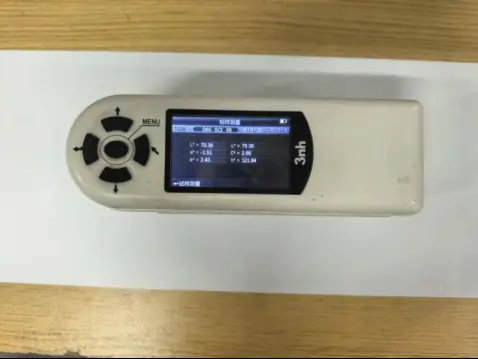
On every production batch we take a 3nh colorimeter reading and compare it to the retained master sample for that colour. A colour and surface sample of the batch is kept on file, so a later order is matched against the original piece — not against someone’s memory of “standard white.” Coating weight and colour are logged per batch; the product pages summarise this as no shade drift between coils when reorders stay inside the controlled batch trail.
Every coil ships with an MTC (mill test / material certificate). Packing lists and coil IDs travel with the load. When you reorder, the fastest path to a match is to quote the prior coil or batch identifier from that paperwork, or to send a physical offcut if the documents are missing. We can also match a RAL reference on request for a new colour — that is a different job from locking a reorder to an existing batch.
Full routine tests — colorimeter, gloss meter, DFT, adhesion, bend — are listed on our quality control page, with the instruments we actually use on the line.
How to reorder without a visible seam
When the first order lands, keep one thing in your file:
- the coil / batch ID from the packing list or MTC, and
- if possible, a small offcut of the framed sheet (even A4-size scrap works).
On the next enquiry, write something like: “Same colour and gloss as order PO-xxxx / coil ID …; match retained colour sample; confirm before coating if the prior batch is exhausted.” If the original batch is gone, we will tell you up front and agree how to approve the next closest retained sample — better than discovering the seam after framing.
MOQ remains 2 t per order (colours can mix inside that tonnage). Lead time is typically 25 days after deposit, FOB Tianjin, with MTC on every coil.
PO checklist for colour-critical reorders
- Quote the prior coil / batch ID (or attach the old MTC / packing list).
- State match retained master sample for that batch — not only “RAL 9016” or “standard white.”
- Name the product: whiteboard, green chalkboard, or black chalkboard (formulations differ).
- Confirm gloss band (white 88–95 GU; green/black 10–16 GU) and DFT 22–24 µm.
- Ask for the batch colour record / instrument reading to ship with the MTC when shade is critical.
- If panels will sit edge-to-edge on one wall, say so — we treat that as a colour-critical job.
- Keep a physical offcut from the first lot for a side-by-side check when the reorder arrives.
Samples before you commit the wall
If you are starting a new colour, or the old batch is closed, ask for a free A4 sample first. Hold it against the boards already on site under your own lights, write and wipe, then freeze that shade into the PO language above. The same habit that protects gloss and erase performance also protects colour continuity — see our five-minute sample test.
Ready to restock without a shade band on the wall? Request a Quote or ask for a free A4 sample of our whiteboard surface — and send the prior coil ID if this is a reorder.
*— Yueyang Technology, Bazhou, Hebei. Write to us — David Hu, General Manager.*